
Over the past twelve months, search activity for removal companies across South London has provided an interesting lens through which to view the local property market. By analysing Google search demand for terms related to removal companies in Clapham, Balham, Tooting, Colliers Wood, Wimbledon and Morden, we can see how consumer behaviour closely tracks wider economic and political signals affecting the housing market.
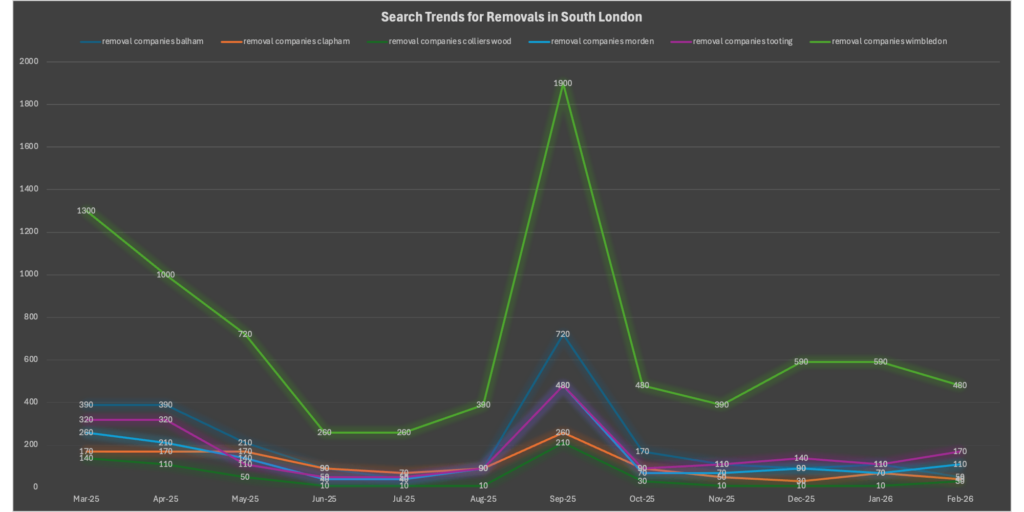
The chart accompanying this article shows the combined monthly search volume trend over the last year for people looking for removal services in these areas. While activity fluctuates throughout the year in line with the typical moving season, one feature stands out clearly: a pronounced spike in September.
Seasonal trends and the South London moving cycle
Demand for removals services is typically linked to the property transaction cycle. Spring and early summer tend to see strong levels of activity as buyers and renters complete moves before the autumn school term or ahead of summer holidays.
In South London, areas such as Clapham, Balham and Wimbledon have particularly active property markets. These neighbourhoods combine strong transport links with a mix of flats and family housing, making them popular with both renters and buyers. As a result, removals demand in these areas tends to mirror broader London housing activity.
During the early part of the year in our dataset, search demand remained relatively stable. However, the most notable change occurs around late summer and early autumn, culminating in the September surge shown in the graph.
The September spike: political uncertainty and delayed decisions
The September increase in search demand coincided with a period of significant uncertainty surrounding government fiscal policy and potential property tax changes ahead of the Autumn Budget.
Throughout late summer and early autumn, speculation grew around whether the government might introduce changes to property taxation, including potential reforms to stamp duty or other housing-related taxes. This uncertainty led many buyers and sellers to delay decisions about moving until the policy outlook became clearer.
Industry commentary at the time suggested the housing market had entered a temporary “holding pattern”. Surveyors reported that some buyers and sellers were pausing property transactions while waiting for the government’s budget announcement, particularly amid rumours of possible tax reforms affecting homeowners and investors.
Major housebuilders also warned that uncertainty surrounding the upcoming budget was weighing on the property market. Barratt Redrow, one of the UK’s largest housebuilders, highlighted that speculation over property taxes and continued mortgage cost pressures were contributing to slower housing activity in the run-up to the announcement.
At the same time, wider housing data showed signs of cooling. House price growth slowed and economists linked part of the slowdown to speculation over tax changes, which encouraged some households to adopt a “wait-and-see” approach to moving home.
What the search data suggests
Against this backdrop, the spike in removals-related searches in September may reflect a release of pent-up demand. When uncertainty begins to lift or decisions can no longer be delayed, transactions often move forward quickly, leading to a surge in related activity such as conveyancing, mortgage approvals and removal bookings.
This phenomenon is well documented in property cycles. Moves that might normally occur gradually across several months can instead cluster around particular moments when confidence returns to the market.
In South London, where housing turnover is typically high due to a mix of renters, first-time buyers and upsizing families, these effects can appear particularly strongly in search data.
The broader economic context
The past year has also been shaped by wider economic factors influencing the UK housing market. Mortgage affordability has remained a central concern, although mortgage approvals did show resilience in parts of the year, reaching a nine-month high in September despite the surrounding uncertainty.
Meanwhile, structural changes in the rental market and policy reforms affecting landlords have also contributed to shifting housing dynamics across London.
A useful indicator of market sentiment
While removal company search volumes are only one piece of the puzzle, they provide a valuable real-time indicator of housing market sentiment. People rarely search for removal companies unless they are actively planning a move, meaning these trends often reflect underlying property activity.
The South London data over the past year highlights how government policy signals, economic conditions and consumer confidence can quickly translate into real-world behaviour.
When buyers and sellers hesitate, the impact is felt across the entire moving ecosystem. And when confidence returns, demand can rebound just as quickly.