
Ready to review
Moving into a flat above the ground floor: stairs, lifts and parking
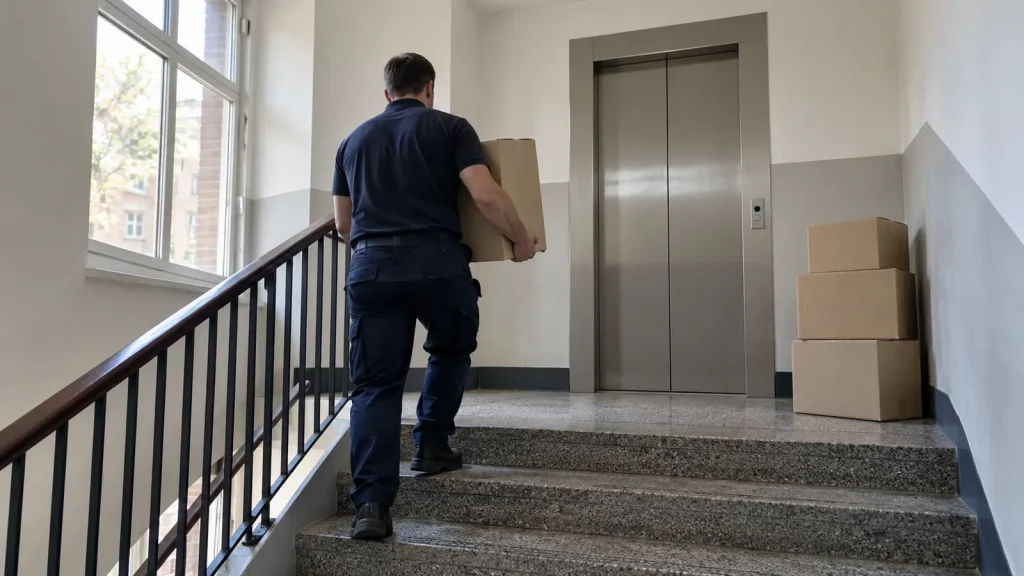
Here we explain what to check before moving into a flat above the ground floor, covering the stairs, the lift and the parking. You will finish with a list of what to find out and what to tell us before the day.
Access sets how long the day takes and how many people we send, because longer carries and awkward routes need more time and care. Problems found on the day are the hardest ones to fix, especially when building rules or parked cars limit the options.
What to check on the stairs when moving into a flat
Every trip up a staircase takes longer than a trip on the level. Stairs add time at your old address and your new one, especially when the crew has a long carry before reaching them.
Measure the turns and landings, or send us clear photos during our removals survey. A tight corner usually stops a large item before the width of the stairs does. Photos taken from both directions help us see the available space.
Sofas, wardrobes, bed frames and mattresses need particular attention. Some furniture may need dismantling before we can get it round a turn. Our guide to moving heavy furniture safely explains how we plan a route through a building.
Communal stairs and hallways belong to everyone in the building. Tell your neighbours and the managing agent about the move in advance. Keep the route clear of bikes, shoes and other belongings. Ask the managing agent whether the building has rules about when removals can take place. We also note where floor and wall protection is needed in the shared areas.
Why the size of the lift matters as much as having one
A lift helps with most boxes, but the size of the lift car and its door sets what will fit. Send us the inside measurements, including the door opening, or we can measure the lift on the survey. Long items such as sofas and wardrobes may still need to go by the stairs, so we check the stairs as a back-up route as well.
Ask the managing agent or concierge whether the lift needs to be booked for a move. Some buildings require a key or protective lift covers, and some limit the hours when removals can use the lift.
Tell us if the lift has been unreliable, and find out who to call if the lift stops working on moving day. A named contact can prevent a long delay while access is sorted out. Holding the lift for long periods affects your new neighbours, so agree with the building staff how lift access will work before the move.
Where the van can park and how far we have to carry
We need to know where a large van can stop at both addresses. Many blocks have height barriers or private car parks, and others have narrow access roads or no loading area. Ask the managing agent about the building’s car park or loading bay, and about any height limit at the barrier. A van may fit through the entrance and still have nowhere suitable to load.
For street parking, check the nearest available space. The space may be a permit bay or have loading restrictions, in which case a council permit or a bay suspension may be needed. Any permission has to be in place before moving day. Council rules and notice periods vary between boroughs, and we will work out with you which one applies. Tight streets come up often for our removals in Balham team, which is why we look at the street as well as the rooms.
We also check how far our team must carry your belongings from the van to the entrance. A longer walk adds time to every trip, on top of the stairs or the lift.
A checklist for a move above the ground floor
A few details help us plan the carry properly.
- Tell us which floor you are leaving and which floor you are moving to.
- Measure the lift and photograph the turns in both staircases.
- Ask the managing agent about booking the lift and permitted moving times.
- Check the barrier height and confirm where our van can load.
- Find out whether parking needs a permit or a bay suspension.
- Measure your largest furniture before moving day.
- Tell your neighbours the moving date.
- Keep hallways, landings and the route to the van clear on moving day.
Frequently asked questions
Will moving into an upper floor flat take longer?
An upper floor move usually takes longer because every trip between the flat and the van takes more time. The final timing depends on the stairs, the lift and the distance from the van to the main door.
What happens if my sofa will not fit in the lift or up the stairs?
Send us the sofa, lift and doorway measurements before moving day. We can check whether the sofa comes apart or another route is possible, and an item that cannot get in is best identified before the move.
Do I need to book the lift in my building?
Many buildings ask residents to book the lift for a move. Check with the managing agent or concierge, then tell us the time slot you are given so our team can plan around it.
When you ask us for a quote, tell us the floor at both addresses, whether each building has a lift and where our van can park. Those details help us plan the right team and allow enough time for your move.