
Ready to review
How to work out how many packing boxes your home will need
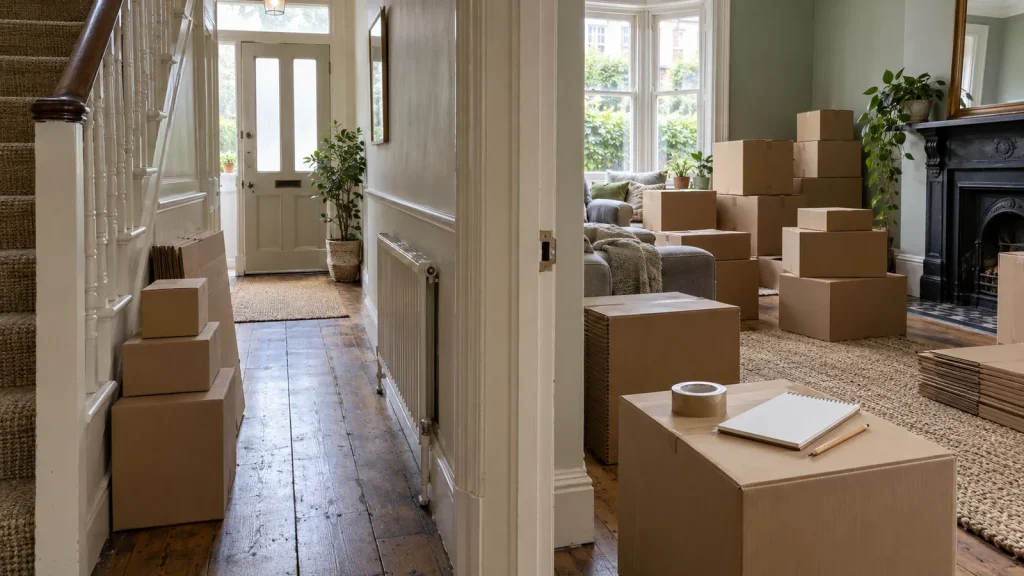
Here is how to work out how many packing boxes your home will need, counting room by room, and which box sizes to order for what. With a sensible estimate in hand, you can order once and pack at a steady pace.
Too few boxes leads to a late-night scramble, with belongings forced into overfilled boxes that split. Too many boxes clutter the home before the move and leave less room to pack properly.
Counting room by room tells you how many packing boxes you need
Walk through each room with a notepad before packing starts. Open every cupboard and every drawer, and look through the loft hatch as well. Count boxes from what you find inside, rather than judging by the size of the room.
A small kitchen can need more boxes than a large bedroom. Crockery and pans take up space, because careful packing leaves fewer items in each box. Books also use more boxes than most people expect, and a large box full of books becomes too heavy to lift safely.
Bedrooms with fitted wardrobes may need fewer standard boxes. Wardrobe boxes hold hanging clothes straight from the rail, which saves folding and repacking.
Include every storage area in your count: the loft, the garage, the shed and the cupboard under the stairs. Forgotten storage spaces often hold enough belongings to change the total. Once every room has been counted, add a few spare boxes for the loose items that turn up on moving day. Our moving house checklist sets out what else to plan in the weeks before.
Rough box numbers for different sizes of home
From our experience, a studio or one-bedroom flat often needs around 20 to 40 boxes. A two-bedroom flat or house often needs around 40 to 60. A three-bedroom house usually needs around 60 to 90, and homes with four bedrooms or more often need 90 boxes and upwards.
Homes vary a great deal, so treat those ranges as a rough starting point. Two homes with the same number of bedrooms can hold very different amounts, and storage space matters as much as floor space.
Lots of books push the total towards the top of the range. A well-stocked kitchen fills more boxes than people expect. Hobby equipment, collections, children’s toys and a full loft all add to the final number.
A removals survey gives a far better figure than any rule of thumb. On a survey we see the actual contents of the cupboards, shelves and storage areas, so our estimate reflects what needs packing in your home.
Matching box sizes to what goes inside
We use small boxes for heavy belongings, so no box becomes too heavy to lift safely. Books, records, tins and tools belong in small boxes. Medium boxes suit most kitchen items, toys and ornaments, with enough packing around anything fragile.
Large boxes work best for light, bulky belongings. Bedding and cushions need the extra space without adding much weight. Lampshades need room too, as squeezing one into a smaller box can damage it. Wardrobe boxes let hanging clothes travel on the rail, so the clothes arrive with fewer creases and go straight back into the wardrobe.
The packing boxes we supply are double-walled, because the bottoms hold under the weight of a packed box. For most homes we suggest a mix weighted towards small and medium boxes, with fewer large ones. The right balance depends on what fills your cupboards and shelves. Tape, packing paper and bubble wrap needs grow with the box count, and fragile belongings take a larger share of the paper and wrap.
A quick checklist before you order boxes
Run through these points before you order, and the estimate will hold up on the day.
- Count every room, including the loft, garage and shed.
- Count books and kitchen items separately, as both need careful packing.
- Agree which rooms we will pack and which you will pack yourself.
- Order a mix of small, medium and large boxes, plus wardrobe boxes.
- Add a few spare boxes for items left until the last day.
- Label each box with its room and contents on two sides.
Frequently asked questions
What happens if I order too many boxes?
If you have unused boxes after the move, we can take them away. Keep the spare boxes clean and dry, and tell our team which ones were not used.
Can I use free supermarket boxes?
Supermarket boxes are often single-walled and come in uneven sizes, so they crush under weight and stack badly in the van. We recommend proper double-walled removal boxes, because they hold their shape and make loading safer.
How early should I start packing?
Start with things you rarely use, such as spare bedding and books, about two weeks before your move. Leave daily essentials until the last day or two.
If you would like us to work out your box count, ask us for a quote and we will include the right mix of boxes and packing materials for your home. Our team can also do the packing for you, if you would rather leave that part of the move to us.